








About Jeff Midkiff
Midkiff will make his Boston Symphony Orchestra debut performing the Concerto on July 23, 2023 at the Tanglewood Music Festival, Thomas Wilkins conducting.Jeff Midkiff
A composer, mandolinist, and clarinetist, Jeff Midkiff is a musician who feels comfortable in more than one musical setting. Jeff grew up in Roanoke, Virginia, where bluegrass music thrived. Given his first mandolin at the age of 7, he moved quickly into the world of fiddlers’ conventions and contests. Midkiff earned a degree in music education from Virginia Tech. While studying classical repertoire, he continued to gain attention as a mandolin and fiddle player. In 1983 he joined the Lonesome River Band, which would eventually become one of bluegrass’s most acclaimed groups. After performing, touring, and recording two albums, he left the band to earn a Master of Music degree in Clarinet Performance from Northern Illinois University. Jeff has spent the last thirty years balancing both musical loves. He has played clarinet in numerous orchestras and has also performed mandolin with the Milwaukee Symphony. His solo CD, Partners In Time, has gained international acclaim. He is an orchestra director in the Roanoke City Schools and received the 2017 Yale Distinguished Music Educator award.
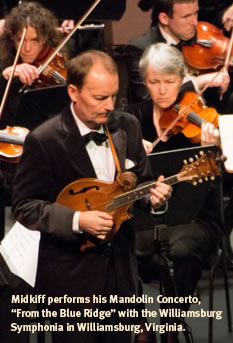
Midkiff’s Mandolin Concerto, “From the Blue Ridge,” was composed and premiered in 2011 for the Roanoke Symphony and their Music Director David Stewart Wiley. The piece has been performed by the Rochester Philharmonic, Jacksonville Symphony, Boulder Philharmonic, Knoxville Symphony, Lancaster Symphony, Champaign-Urbana Symphony, Shreveport Symphony, Williamsburg Symphony, Bryan Symphony, Northwest Florida Symphony, Symphony of Southeast Texas, Ohio Northern Symphony, Cal Poly Symphony, Carmel Symphony, Signature Symphony at TCC, Oak Ridge Symphony, Bryan Symphony, Lancaster Symphony, and the Yale Concert Band. Midkiff will make his Boston Symphony Orchestra debut performing the Concerto on July 23, 2023 at the Tanglewood Music Festival, Thomas Wilkins conducting.
The Concerto gained national recognition when it was performed at the Kennedy Center with the Boulder Philharmonic as part of the 2017 SHIFT Festival. The performance received enthusiastic praise. Alex Ross, writing for the New Yorker, described the performance as “...lit up by improvisatory bursts of bluegrass and mountain fiddling. [Midkiff's] mellow virtuosity elicited youthful yelps from the upper galleries of the hall.” Philip Kennicott, of the Washington Post, wrote: "The most exciting moments came during Jeff Midkiff's Mandolin Concerto, especially the last movement... The playing was virtuosic and exuberant."
Jeff’s unique collaboration with the Carpe Diem String Quartet resulted in the new CD, “Jeff Midkiff: Music for Mandolin and String Quartet.” The CD won the Global Music Awards Gold Medal. The First Quintet (2015) is an arrangement of the Mandolin Concerto, “From the Blue Ridge.” The Second Quintet was premiered in 2017. The ensemble performed the work at Weill Recital Hall at Carnegie Hall, New York in 2019.
Jeff Midkiff: "How do you get to Carnegie Hall?”
by David Royko
“While there are plenty of musicians who play more than one instrument professionally, they are of the same family. Not Jeff. He’s also a clarinetist.”You’ve heard the old joke.
Seeking directions, a guy asks a musician, “How do you get to Carnegie Hall?” The answer: “Practice.”
If he’d asked Jeff Midkiff, the answer would have been, “Practice — the mandolin.” I guess some might consider that a joke within a joke.
Not Midkiff, or anyone aware of this musical polymath’s talents and uniquely illustrious career. While there are plenty of musicians who play more than one instrument professionally, they are of the same family, like various string instruments (guitar + mandolin), or woodwinds (saxophone + clarinet) or brass (trumpet + flugelhorn).
Not Jeff. He’s also a clarinetist, and between reed and strings, he has performed with opera companies and symphony orchestras. And that is symphony orchestras, plural: Milwaukee, Knoxville, Shreveport, Champaign-Urbana, Jacksonville, Williamsburg, Northwest Florida, Southeast Texas, Ohio Northern, and Cal Poly Symphony Orchestras, the Rochester and Boulder Philharmonics, and the Yale Concert Band. All have had the honor of featuring Midkiff. And speaking of Yale, they gave him their Distinguished Music Educator award in 2017. It was for his work as a music educator and Orchestra Director for the Roanoke City Schools — Midkiff holds a bachelor’s degree in Music Education and a Masters in clarinet performance.
The mandolin is how Jeff got to the stage of Carnegie Hall. The Kennedy Center too. And not just as a picker, but as a composer. Mandolin concertos — one a double concerto for mandolin and violin — and chamber music have come from his fertile musical mind.
So Midkiff’s not your typical mandolinst. But that doesn’t mean he hasn’t also graced the stages of equally distinguished bluegrass festivals, including Grey Fox, Bean Blossom and Strawberry (sort of the Salzburg Festivals of the bluegrass world), beginning his career as the inaugural eight-stringer in the 1980s with the renowned Lonesome River Band, filling that role on their first two albums, as well as the New Grass Revue, McPeak Brothers, Bluegrass Express, and The Schankman Twins.
Things like that can happen when you grow up in Bluegrass country (Roanoke), pick up an instrument when you’re seven, and never put it down.
His profile rose higher in 2003 with the release of Partners in Time, praised by Bluegrass Now staff writer Joe Ross as a “splendid solo debut” by a “superior instrumentalist who pushes the envelope.”
Midkiff’s muse is melodic, accessible, and bothcrowdpleasing and unpretentiously sophisticated. As composers go, he’s the real deal.
Yet how many musicians get a review like that from a bluegrass authority, and then receive praise from the classical world’s top scribes, such as the New Yorker’s Alex Ross, and the Washington Post’s Philip Kennicott, both of whom have written glowingly of Midkiff? Actually, his 2011 Mandolin Concerto, “From the Blue Ridge,” the 2014 “Double Concerto for Mandolin, Violin and Orchestra,” and two quintets, the first a reworking of “From the Blue Ridge,” and the second, from 2017, subtitled “Gypsy,” receive enthusiastic praise wherever they’re performed. Midkiff’s muse is melodic, accessible, and both crowd-pleasing and unpretentiously sophisticated. As composers go, he’s the real deal.
Midkiff is also fortunate to have found an ideal group to bring his quintets from the page to the ear. The Carpe Diem String Quartet, hailing from Columbus, Ohio, revels in modern composers like Osvaldo Golijov and Gunther Schuller along with the usual giants — Mozart, Beethoven — and includes Yo-Yo Ma and Richard Stoltzman as collaborators.
Hey, another virtuoso string player, and another virtuoso clarinetist. Coincidence? Not likely.
With Midkiff, it’s just two sides of one musical gold coin.
—David Royko
